


In 2025 the budget segment tightened around a few standout models that offer professional features without premium prices. Each pick balances display quality, battery endurance and real‑world performance in ways that matter most to everyday users. The lineup below highlights devices that avoid obvious compromises — but the tradeoffs are subtle, and choosing the right one depends on personal priorities.
- Lava Play Ultra 5G Smartphone (Arctic Frost, 128GB)
- Motorola G45 5G (Brilliant Blue, 8GB RAM, 128GB Storage)
- Redmi 14C 5G Smartphone (Stargaze Black, 6GB RAM, 128GB)
- POCO M6 5G Smartphone (4GB RAM, 64GB)
- realme NARZO 80 Lite 5G Smartphone (6GB+128GB, Crystal Purple)
- Factors to Consider When Choosing 5 Budget Smartphones in 2025
- Performance & Chipset
- Display Quality
- Battery Life & Charging
- Camera Capabilities
- Software & Updates
- Build & Durability
- Connectivity & Extras
- Conclusion
Lava Play Ultra 5G Smartphone (Arctic Frost, 128GB)
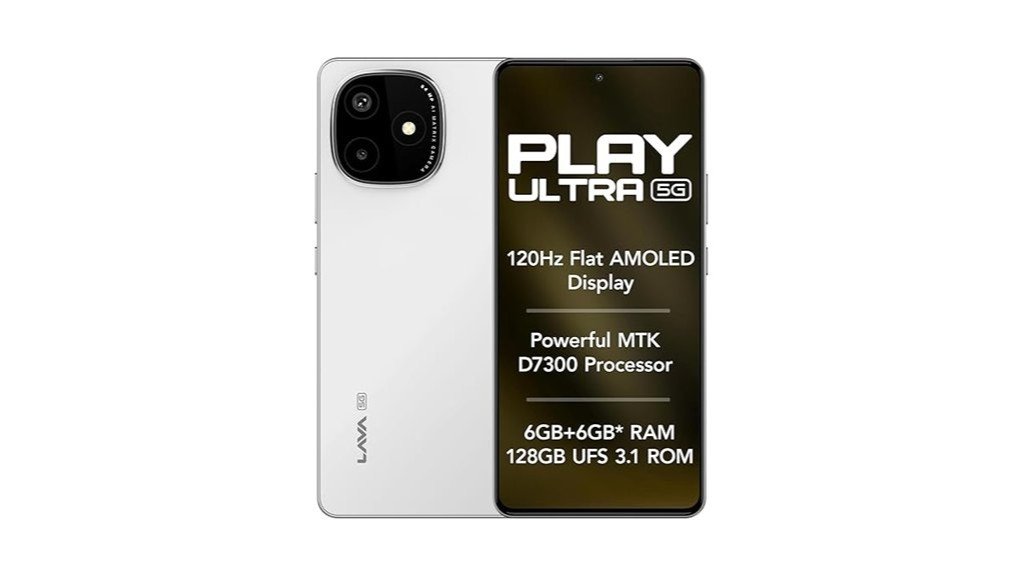
For buyers seeking flagship-like speed on a tight budget, the Lava Play Ultra 5G (Arctic Frost, 128GB) stands out with its MTK D7300 4nm chipset and UFS 3.1 storage, delivering smooth app loading and strong real-world performance while keeping costs under ₹15,000. It pairs a 6.67″ FHD+ 120Hz AMOLED, 1200 nits peak, with 6GB RAM plus 6GB expansion (LPDDR4X) and Android 15 near-stock OS. A 64MP Sony IMX682 main camera, dual stereo speakers, 5000 mAh battery with 33W charging, IP64 rating, and Panda protection glass round out a compelling value package.
Best For: Buyers who want flagship-like speed and smooth everyday performance on a tight budget, with a bright AMOLED display and long battery life.
Pros:
- Powerful MTK D7300 4nm chipset + UFS 3.1 storage delivers fast app loading and strong real-world performance.
- 6.67″ FHD+ 120Hz AMOLED (1200 nits peak) with 6GB + 6GB expandable RAM and near-stock Android 15 for a clean, smooth UI.
- 5000 mAh battery with 33W fast charging, dual stereo speakers, 64MP Sony IMX682 main camera, and IP64 build — excellent value under ₹15,000.
Cons:
- Display visibility outdoors can be limited for some users; HDR playback not supported in some apps.
- Panda protection glass (not Gorilla Glass) and IP64 offer moderate rather than top-tier durability.
- RAM is LPDDR4X (not the newer LPDDR5) and some reviewers noted slower display animations due to lack of a custom UI.
Motorola G45 5G (Brilliant Blue, 8GB RAM, 128GB Storage)
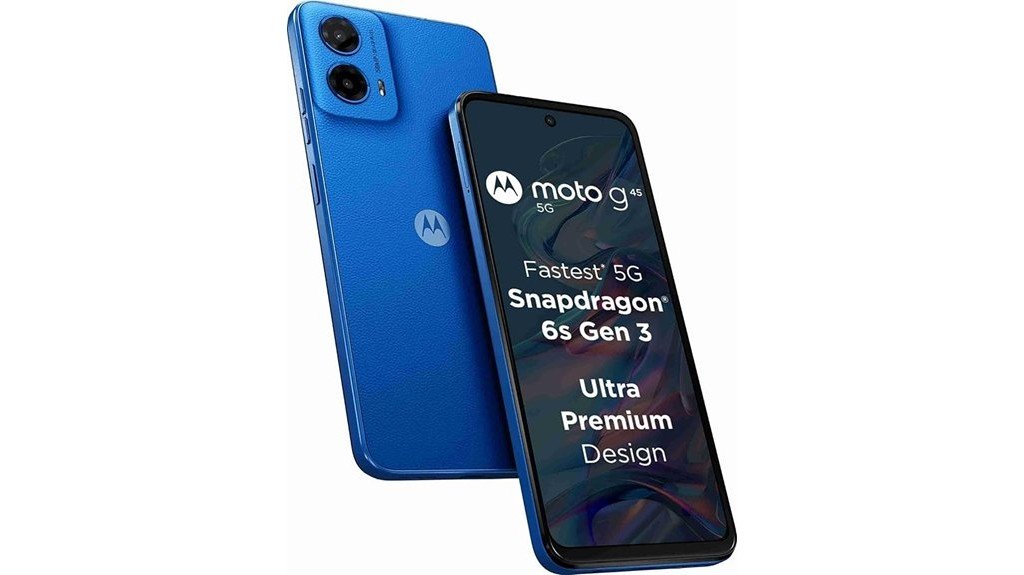
Targeted at users who prioritize battery life and smooth daily use without premium price, the Motorola G45 5G pairs a 5,000 mAh battery with a 120 Hz display and an efficient Snapdragon 6s Gen 3 to deliver long-lasting, responsive performance for streaming, multitasking, and casual gaming. Running Android 14 with a clean Motorola skin, the Brilliant Blue G45 offers 8GB RAM and 128GB storage, reliable benchmarks, and minimal bloat. Downsides include a 720p panel below AMOLED rivals, camera app sluggishness and weak macro performance, slower 20W charging, hybrid SIM/microSD tradeoffs and occasional notifications from preinstalled apps. Overall: solid value.
Best For: Users seeking a budget-friendly 5G phone with excellent battery life and smooth everyday performance for streaming, multitasking, and casual gaming.
Pros:
- 5,000 mAh battery and efficient Snapdragon 6s Gen 3 deliver long-lasting, responsive day‑to‑day use.
- 120 Hz display provides fluid navigation and scrolling.
- Clean Android 14 experience with 8 GB RAM and 128 GB storage, minimal bloat for good value.
Cons:
- 720p LCD panel is less sharp and vibrant than AMOLED competitors.
- Camera software can be sluggish and macro shots underwhelm.
- Slower 20 W charging and hybrid SIM/microSD slot limit convenience.
Redmi 14C 5G Smartphone (Stargaze Black, 6GB RAM, 128GB)
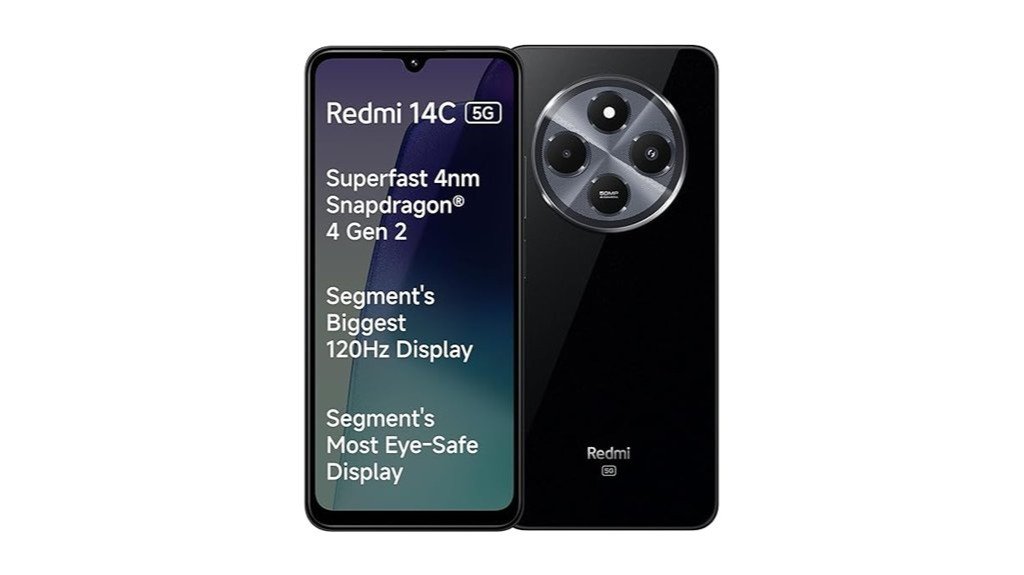
Offering a large 6.88″ 120 Hz display and long-lasting 5,160 mAh battery at a sub‑midrange price, the Redmi 14C 5G is suited for users who prioritize smooth everyday performance and all‑day endurance without premium costs. The Stargaze Black bar design looks premium; the phone weighs 205 g and measures 17.2 x 7.8 x 0.8 cm. A Snapdragon 4 Gen 2 chipset, 6 GB RAM (expandable virtually), 128 GB storage and microSD support deliver competent multitasking. The 50 MP dual rear camera captures crisp daily photos, while a 5 MP front cam handles selfies. Included: 33 W charger, Android 14, side fingerprint sensor.
Best For: users seeking a large, smooth 120 Hz display and all‑day battery life in an affordable 5G smartphone with competent everyday performance.
Pros:
- Long‑lasting 5160 mAh battery with included 33 W charger for quick top‑ups.
- Large 6.88″ 120 Hz display with 600 nits peak brightness and 240 Hz touch sampling for smooth media and gaming.
- Solid everyday performance from Snapdragon 4 Gen 2, 6 GB RAM (expandable virtually) and 128 GB storage with microSD support.
Cons:
- 720p (1640) resolution on a large display may appear less sharp compared with higher‑res phones.
- Front camera is only 5 MP, limiting selfie quality in low light.
- Processor and camera are midrange‑oriented, so not ideal for heavy gaming or premium photography.
POCO M6 5G Smartphone (4GB RAM, 64GB)
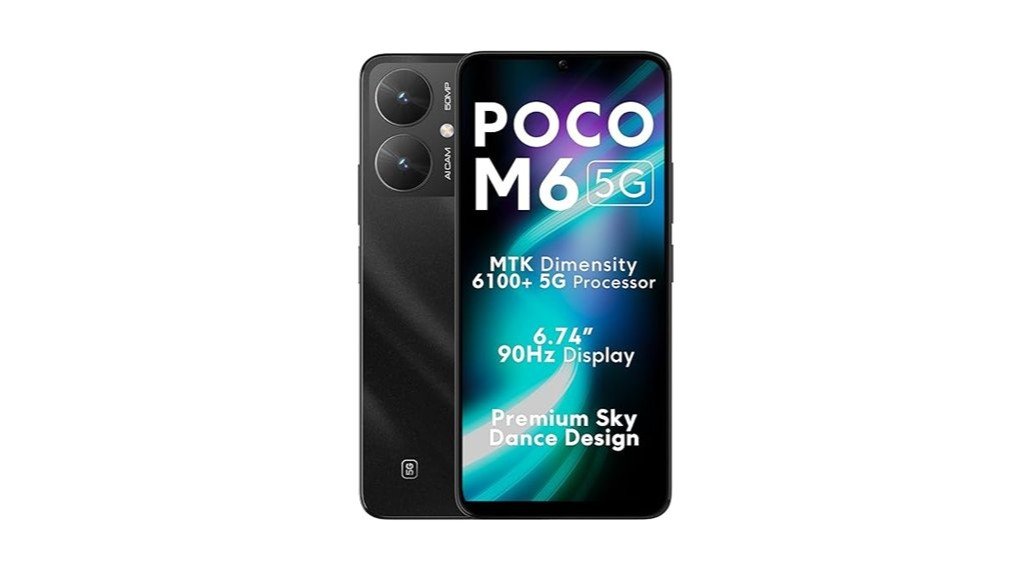
The POCO M6 5G (4GB/64GB) suits budget-conscious users who prioritize long battery life and basic 5G performance, thanks to its 5000 mAh battery and MediaTek Dimensity 6100+ chipset. The 6.74″ HD+ 90 Hz display with Gorilla Glass 3 and 600 nits peak is usable though not sharp. Android 13 with MIUI 14/HyperOS updates delivers day-to-day smoothness; occasional lag and missing MIUI features have been reported. Camera performance is mixed despite a 50 MP AI primary sensor. Extras include dual nano‑SIM plus microSD, 18W charging, 3.5 mm jack, side fingerprint sensor and a 195 g build.
Best For: budget-conscious users who want long battery life and basic 5G performance in a lightweight phone.
Pros:
- Large 5000 mAh battery with reliable all-day use and 18W fast charging.
- Affordable 5G-capable MediaTek Dimensity 6100+ chipset for smooth everyday performance.
- 6.74″ 90 Hz display with Gorilla Glass 3 and 3.5 mm jack, plus expandable storage (microSD) and side fingerprint sensor.
Cons:
- 720p HD+ display is not very sharp on a large screen.
- Mixed camera performance despite a 50 MP sensor; some users report poor photos.
- Occasional lag and missing MIUI features on some builds (feature availability improved after HyperOS updates).
realme NARZO 80 Lite 5G Smartphone (6GB+128GB, Crystal Purple)
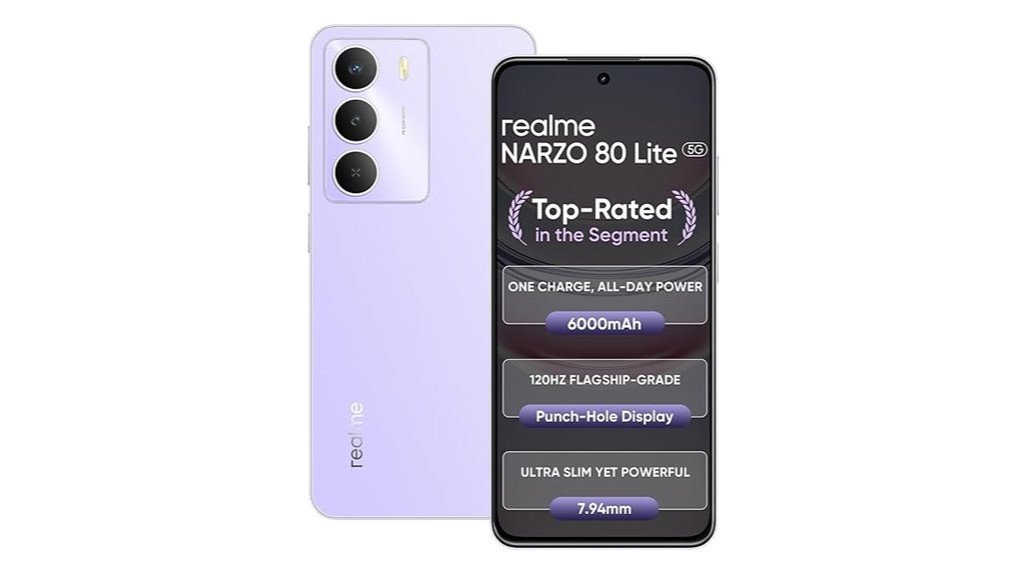
Suited for users who prioritize battery life and lightweight 5G performance on a budget, the realme NARZO 80 Lite 5G pairs a 6000 mAh battery and a power-efficient MediaTek Dimensity 6300 with a slim 7.94 mm profile and IP64 resistance, making it a practical daily driver for long commutes and extended use. The Crystal Purple 6GB/128GB model runs Android 15, weighs 197 g and features a 120 Hz punch-hole display (720×1604), 32 MP rear plus 8 MP front cameras, 3.5 mm jack, USB, Wi‑Fi and GPS. Claims include military-grade durability; users note excellent battery life, good sound, occasional heating and slow charging.
Best For: Budget-conscious users who need long battery life and lightweight 5G performance for daily commuting and extended use.
Pros:
- 6000 mAh battery offers excellent endurance for multi-day use or heavy daily use.
- Slim 7.94 mm design with IP64 resistance and a lightweight 197 g body for comfortable portability.
- 120 Hz punch-hole display and MediaTek Dimensity 6300 5G deliver smooth, power-efficient performance for everyday tasks.
Cons:
- 720×1604 resolution is modest compared with higher-resolution rivals.
- Charging speed is reported as slow by some users despite the large battery.
- Camera performance is average for the budget segment, and occasional heating/hanging has been reported.
Factors to Consider When Choosing 5 Budget Smartphones in 2025
When selecting five budget smartphones for 2025, priority should be given to real-world performance and the efficiency of the chipset. Display quality, battery life and charging speed, and camera capabilities determine everyday usability and photographic results. Ongoing software support and timely updates are essential for security and long-term value.
Performance & Chipset
Why pick a recent mid‑range chipset instead of an older model? Recent 4nm–6nm SoCs deliver markedly better CPU/GPU efficiency and battery life versus 8–12nm parts, making them the smarter choice for budget buyers. Prioritize chips with proven real‑world performance (roughly ≳700K AnTuTu or equivalent) when gaming or heavy multitasking is expected, since higher scores generally indicate smoother app loading and sustained throughput. Verify RAM and storage types—LPDDR4X/LRDDR5 and UFS 3.1+ materially reduce load times and stutter. Favor balanced big.LITTLE designs to minimize thermal throttling and preserve sustained performance over burst benchmarks. Finally, factor in platform support: timely OS and chipset driver updates matter for long‑term stability and performance as much as the silicon itself.
Display Quality
For budget shoppers evaluating five contenders in 2025, display quality should be treated as a primary differentiator because panel type, resolution, refresh rate, and brightness together dictate everyday legibility, color fidelity, and perceived smoothness. Panel choice is foundational: AMOLED typically yields deeper blacks, higher contrast, and richer saturation than LCD at similar prices. Native resolution and pixel density matter for sharpness—aim for FHD+ or roughly 400 PPI on 6–7″ screens to preserve text and fine detail. Refresh rate influences perceived fluidity; 90–120 Hz feels notably smoother than 60 Hz though it can increase power draw. Brightness and outdoor legibility require sufficient peak and sustained nits (around 600+ preferred). Finally, prioritize wide color gamut, accurate tuning, and real HDR playback for better video and photo rendering.
Battery Life & Charging
In 2025, battery life and charging remain central selection criteria for budget smartphones, since capacity, charging speed, and long‑term battery care together determine how reliably a device lasts through a day or several without compromising portability. Buyers should prioritize capacity and real‑world endurance estimates: ~5000–6000 mAh typically yields a full day to 1.5–2 days of mixed use, while ≤4000 mAh often demands daily top‑ups. Charging power matters: 30–65W fast charging cuts plug‑in time substantially (30W+ can hit ~50% in 30 minutes) compared with 10–20W. Check supported protocols (USB‑PD, PPS, proprietary) and included adapter wattage so advertised speeds are usable. Also assess longevity features—adaptive charging, battery health management, and efficient SoCs/OS optimizations—and weigh larger batteries against added weight and thickness.
Camera Capabilities
Many buyers should evaluate camera systems by their components and processing rather than headline megapixels alone; sensor size, aperture, and stabilization (OIS/EIS) typically drive low‑light and video performance more than raw pixel counts. A 50–64MP sensor with EIS can outperform a higher‑MP unit that uses a smaller, lower‑quality sensor. Assess ultrawide, macro, and depth modules for real‑world utility: 5MP macro or depth cameras often add little compared with a reliable primary plus a usable ultrawide or telemacro with larger pixels. Confirm front and rear video specs — max resolution, frame rates, and HDR support — since 1080p/4K at 30–60fps and HDR affect content quality. Finally, prioritize processing features such as HDR tone mapping, night mode, multi‑frame noise reduction, dual‑tone flash, stabilization, and RAW/DNG support for better low‑light, steadier video, and editing flexibility.
Software & Updates
Software support and update cadence are core longevity factors when choosing a budget smartphone in 2025. Buyers should prioritize phones that ship with a recent Android major release (Android 14–15) to maximize compatibility and immediate security support. Manufacturer promises matter: prefer devices offering at least two major Android upgrades and three years of monthly or quarterly security patches. Confirm whether the software is near‑stock or heavily skinned; near‑stock builds typically mean fewer preinstalled apps, smaller update delays, and steadier performance. Check the vendor’s track record for rolling out OTA security patches within 30–90 days of Google’s releases. Finally, evaluate extra features like RAM expansion or custom camera processing only after ensuring clear, enforceable update commitments that protect value over time.
Build & Durability
For buyers weighing budget phones in 2025, build quality and durability separate short‑lived bargains from genuinely practical devices: check ingress‑protection ratings for splash and dust resistance, favor chemically strengthened or named impact‑resistant glass over unspecified “generic” panels, and prefer metal or reinforced polycarbonate frames to unreinforced plastic for better structural rigidity and drop resilience. Verify claimed military or shock resistance by noting the specific standard (for example, MIL‑STD‑810G) and reviewing which tests were performed. Assess thickness and weight as crude proxies for internal reinforcement. Finally, value practical inclusions that reduce damage risk and repair cost: preinstalled screen protectors, supplied protective cases, and clear official repair/service options. Marketing terms without specifics should be treated cautiously.
Connectivity & Extras
Connectivity and extras determine how well a budget phone fits into daily life beyond raw performance: buyers should prioritize 5G band compatibility with their carrier, at least Wi‑Fi 5 (preferably Wi‑Fi 6) and Bluetooth 5.2+, and hardware conveniences such as dual‑SIM or microSD options, NFC, a 3.5 mm jack if needed, reliable stereo or dual‑mic audio, and clear details on USB‑C fast-charging or wireless charging support. Buyers should confirm the device supports current regional 5G groups (Sub‑6 GHz commonly) and verify carrier band lists for real‑world access. Dual‑SIM versus dedicated microSD is a decisive trade for those needing both. Check wireless standards for accessory stability, confirm presence of NFC and audio ports if required, and note fast‑charge wattage plus any IP rating for everyday reliability.
Conclusion
In 2025’s crowded budget market, these five models—Lava Play Ultra 5G, Motorola G45, Redmi 14C, POCO M6 and realme NARZO 80 Lite—stand out by delivering flagship‑inspired features without hefty price tags. They balance displays, battery life, performance and storage differently to suit varied priorities, proving excellent value for money. Buyers seeking punchy screens, long endurance, smooth daily use or expandable storage can confidently find a capable, well‑rounded choice among them.