
For those arranging a compact work‑from‑home audio setup, clear midrange and controlled bass matter more than loudness. A short list of USB‑powered, desk‑friendly models balances vocal clarity for calls with enough low end for background music. Each choice prioritizes small footprint, simple connectivity and sensible controls, leaving a straightforward comparison that helps pick what suits a specific desk and budget.
- Creative Pebble 2.0 USB-Powered Desktop Speakers (White)
- Zebronics Fame 2.0 USB Computer Speakers (5W, USB Powered, AUX, Volume Control)
- Ant Esports GS195 RGB USB-Powered Mini Computer Speakers with 3.5mm Aux (10W)
- HP DHS-2111 Wired 2-Channel Speaker with 3.5mm Aux (Black)
- FRONTECH 2.0 Multimedia Speakers with USB Power and AUX Connectivity (SPK-0002BLK)
- Factors to Consider When Choosing Speakers for Work From Home Setup
- Sound Quality and Clarity
- Connectivity and Compatibility
- Size and Desk Footprint
- Power and Volume Needs
- Comfort and Ergonomics
- Budget and Value
- Conclusion
Creative Pebble 2.0 USB-Powered Desktop Speakers (White)
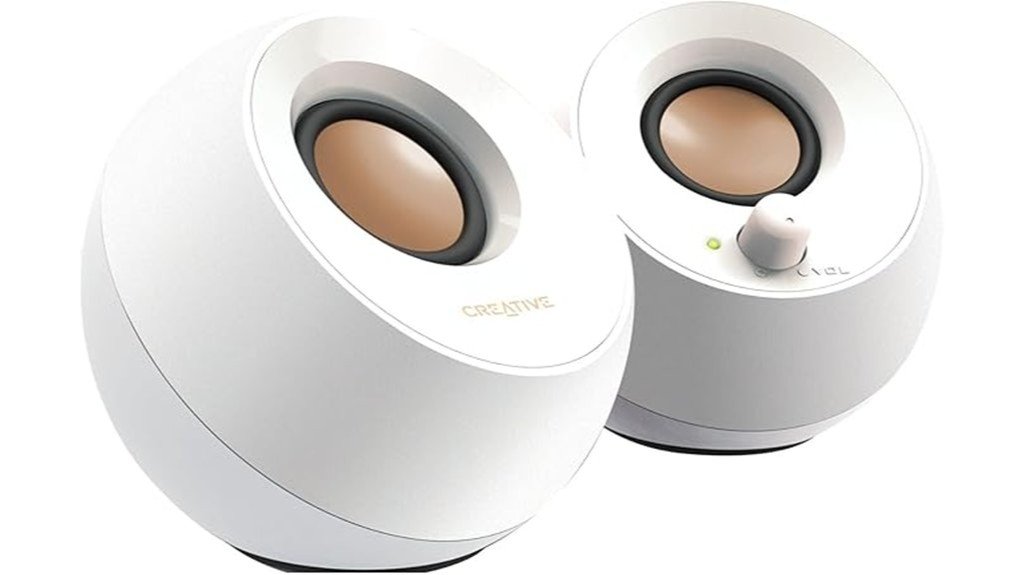
The Creative Pebble 2.0 USB-Powered Desktop Speakers (White) suit remote workers who need compact, plug-and-play audio with clear highs and enhanced bass. Designed as a 2.0 active desktop pair, they use 45° far-field drivers and rear passive radiators to improve projection and low-end response. USB-C power-plus-audio (USB-A adapter included) enables simple setup with PCs and laptops; front-facing volume control offers immediate adjustment. At 4.4W RMS, they outperform built-in monitor speakers for calls, music, and casual gaming. The plastic pebble build is tabletop-mounted, lightweight, and backed by a one-year warranty and broad user approval.
Best For: Remote workers and desktop users who want compact, plug-and-play speakers that deliver clear highs, improved midrange, and enhanced bass compared with built-in laptop or monitor speakers.
Pros:
- Compact, stylish tabletop design with 45° far-field drivers for direct sound projection and good clarity for calls, music, and gaming.
- Simple USB-C power-plus-audio setup (USB-A adapter included) — plug-and-play with front-facing volume control.
- Rear passive radiators provide surprisingly good bass for a 2.0 pair at an excellent price-to-performance ratio and 1-year warranty.
Cons:
- Limited overall power (4.4W RMS) and bass extension compared with powered speakers or systems with a subwoofer.
- Some models/uses may require a USB-C port that supplies both audio and sufficient power for best performance; limited compatibility with certain power sources.
- No advanced wireless codecs or app/customization; build is plastic and not suited for heavy-duty or audiophile listening.
Zebronics Fame 2.0 USB Computer Speakers (5W, USB Powered, AUX, Volume Control)
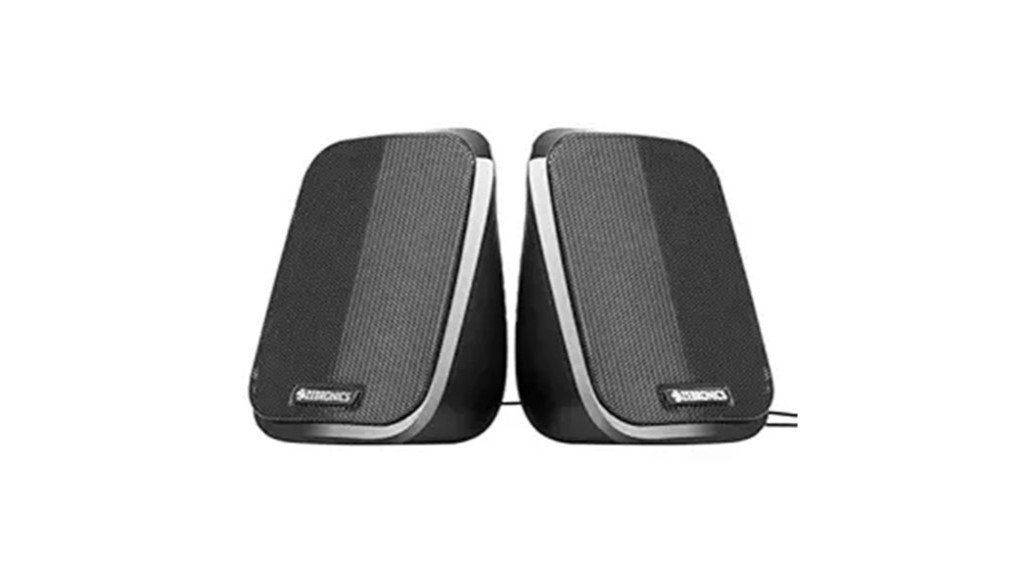
Compact and USB-powered, the Zebronics Fame 2.0 is ideal for remote workers who need an affordable, no-fuss desktop audio upgrade. This compact 2.0 system delivers 5W output from dual 5.2 cm dynamic drivers, offering balanced stereo and reasonably enhanced bass for casual music, calls, and video. It is USB powered and uses a 3.5 mm AUX input, with a volume control pod for quick adjustments. Plug-and-play setup is straightforward, though some laptops require both USB and AUX ports. Lightweight and tabletop-friendly, it’s a budget-friendly, well-built option with limited bass and short cable length.
Best For: remote workers and budget-conscious desktop users who want a compact, plug-and-play USB-powered speaker upgrade for music, calls, and video.
Pros:
- Compact, lightweight tabletop design with easy plug-and-play USB power and 3.5 mm AUX connectivity.
- Clear, balanced stereo sound from dual 5.2 cm drivers with decent bass for casual listening.
- Affordable, well-built option with simple volume control pod for quick adjustments.
Cons:
- Requires both USB power and AUX connections on some devices, which may be inconvenient.
- Limited bass depth and not suitable for high-end audio or heavy bass tracks.
- Short cable length can restrict speaker placement and stereo separation.
Ant Esports GS195 RGB USB-Powered Mini Computer Speakers with 3.5mm Aux (10W)
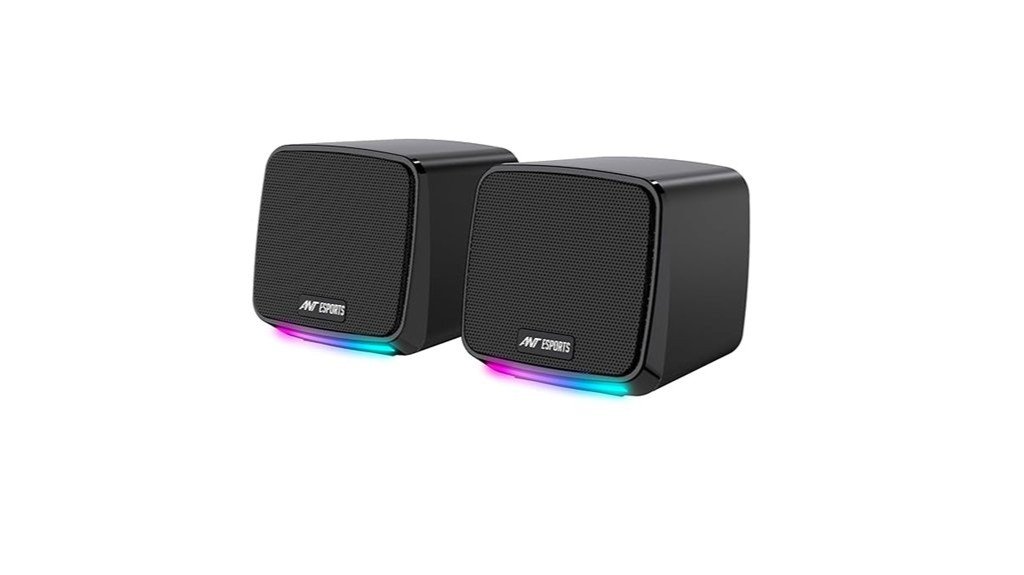
Suited for budget-conscious remote workers who need plug-and-play audio, the Ant Esports GS195 delivers USB-powered convenience with 3.5 mm aux input and dynamic RGB lighting. The compact column speakers (10 x 6.6 x 8 cm, 240 g) feature 3.5-inch drivers, 1-inch tweeters, and a matte metal front with anti-slip pads. Included USB and aux cables enable quick setup; inline volume control and app-based adjustments offer basic control. Advertised at 10 W, real-world output measures nearer 5–6 W. Sound is described as crisp for calls and casual media, though reviews note lower loudness and mixed user satisfaction. Limited warranty.
Best For: Budget-conscious remote workers or casual gamers who want compact, plug-and-play USB-powered speakers with RGB lighting for calls and everyday media.
Pros:
- Compact, lightweight design with matte metal front and anti-slip pads — easy to place on a desk.
- Plug-and-play USB power plus 3.5 mm aux input and inline volume control for simple setup and use.
- Dynamic RGB lighting and app-based adjustments add flair and basic customization for a gaming/work atmosphere.
Cons:
- Advertised 10 W power but real-world output closer to 5–6 W, so not very loud for larger rooms.
- Mixed user feedback and low customer rating indicating potential quality or performance concerns.
- Limited warranty and basic feature set compared with higher-end PC speakers (lower fidelity and loudness).
HP DHS-2111 Wired 2-Channel Speaker with 3.5mm Aux (Black)
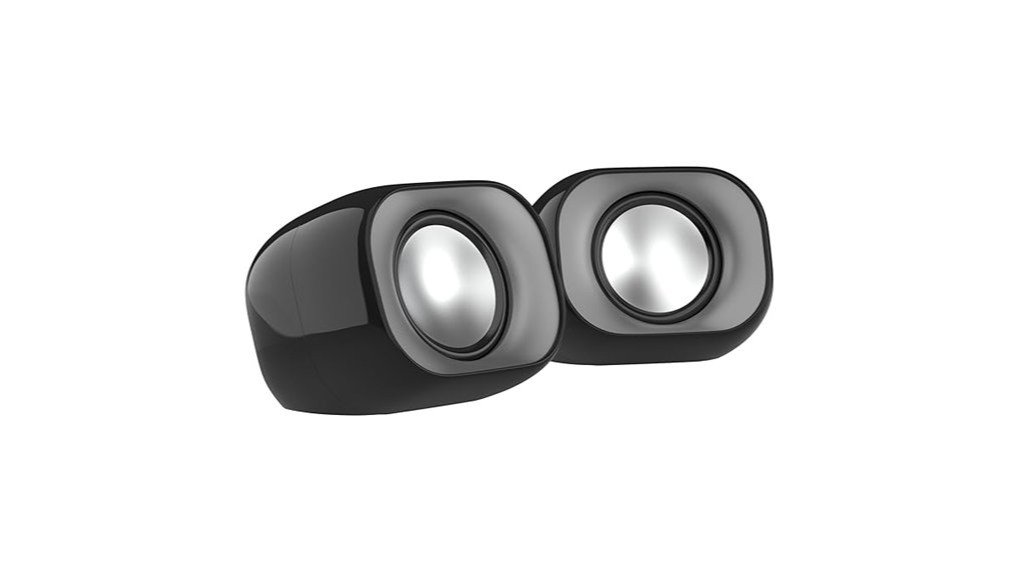
Aimed at budget-conscious remote workers who need clear near-field audio, the HP DHS-2111 delivers a simple plug-and-play solution with 3.5mm aux connectivity and USB power. The compact black speakers use a 2.0 dynamic driver configuration with a 1-inch tweeter and 6 W total output, intended for under-monitor placement and casual music or call use. Controls are via a wired volume knob; an app is listed but primary operation is physical. At 270 g with glossy plastic finish, the DHS-2111 offers basic performance, a one-year warranty, and solid user ratings, though volume and audiophile fidelity are limited.
Best For: Budget-conscious remote workers who need clear near-field audio for calls and casual music with a simple plug-and-play setup.
Pros:
- Compact, under-monitor design with glossy black finish ideal for small desks.
- Simple plug-and-play connectivity via 3.5mm aux and USB power; wired volume knob for easy control.
- Affordable with a 1-year warranty and generally positive user ratings for value and clarity.
Cons:
- Limited overall loudness and not suitable for larger rooms or audiophile listening.
- Basic plastic build and cable management issues reported by users.
- No water resistance and app control is secondary to the wired knob.
FRONTECH 2.0 Multimedia Speakers with USB Power and AUX Connectivity (SPK-0002BLK)
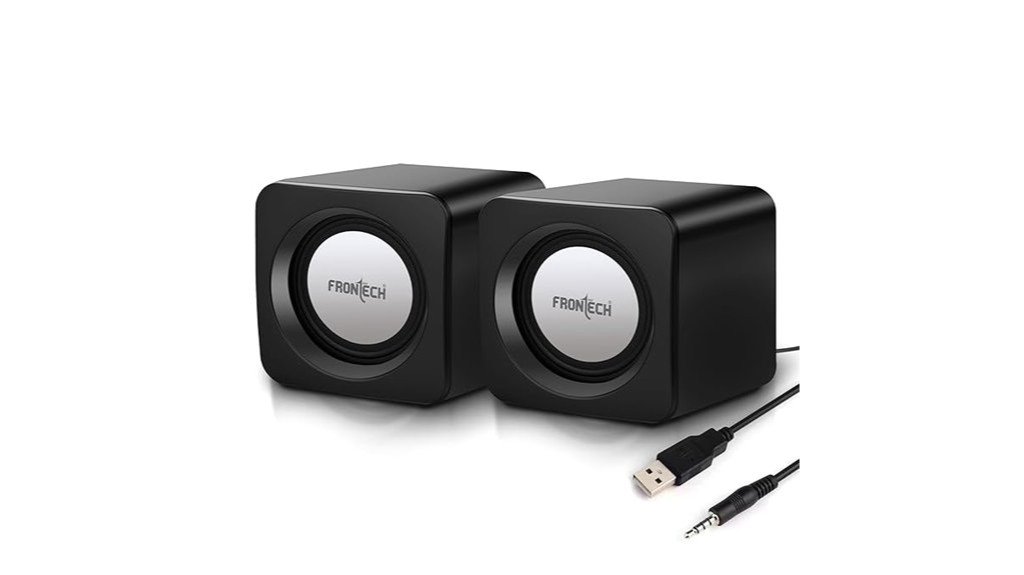
For remote workers who need a simple, budget-friendly desktop audio solution, the FRONTECH 2.0 Multimedia Speakers (SPK-0002BLK) stand out for their plug-and-play USB power and 3.5 mm AUX connectivity, delivering clear vocal-forward sound from two 2-inch dynamic drivers. Compact and lightweight, the coaxial 2.0 system offers a built-in volume dial and touch controls, drawing 5V USB power for easy hookup to laptops, power banks, or adapters. Users praise value and intelligibility for calls, while noting limited bass, short cables, and mixed quality reports; foam stuffing and EQ tweaks can reduce resonance and improve balance.
Best For: Remote workers and budget-conscious desktop users who need a compact, plug-and-play speaker setup for clearer voice calls and basic media playback.
Pros:
- Affordable, compact 2.0 coaxial design with clear, vocal-forward sound ideal for calls.
- Simple plug-and-play USB power (5V) plus 3.5 mm AUX for wide device compatibility (laptops, desktops, phones, power banks).
- Built-in volume dial and lightweight portable pair (260 g) make setup and placement easy.
Cons:
- Limited bass response and overall low volume for music or richer audio needs.
- Short cables and occasional inconsistent build/quality reports from some buyers.
- Mixed customer support experience and reported variability in units (color/working condition).
Factors to Consider When Choosing Speakers for Work From Home Setup
When selecting speakers for a work-from-home setup, practical considerations shape the choice: sound quality and clarity, connection options and device compatibility, and the physical size relative to desk space. Power and maximum volume should match the room size and typical use, while ergonomic placement and control accessibility affect long-term comfort. Prioritizing these factors helps ensure the speakers support both calls and media without creating clutter or fatigue.
Sound Quality and Clarity
How should speakers reproduce voice and detail in a home office without sounding colored or harsh? Speakers should aim for a flat, neutral frequency response across roughly 20 Hz–20 kHz with minimal peaks in the 2–5 kHz range to keep vocals natural and non-fatiguing. A dedicated midrange driver or well-tuned full-range drivers helps preserve intelligibility, since 300 Hz–4 kHz carries speech. Total harmonic distortion under 1% at normal listening levels prevents muddiness during complex passages or multi-speaker calls. An SNR of at least 80 dB and a low noise floor reduce hiss and USB/line interference that can mask subtle speech cues. Finally, controlled bass—rolling off below about 60–80 Hz—and good stereo imaging stop low frequencies from overwhelming mids in small desktop spaces.
Connectivity and Compatibility
In assessing speakers for a home office, connectivity and compatibility determine whether the device integrates smoothly with existing hardware and workflow. Buyers should check available ports on the PC or laptop—USB-C with audio+power, USB-A, or 3.5 mm aux—since some powered speakers need a single USB connection while others require separate USB power plus a 3.5 mm input. Decide if wireless Bluetooth is necessary and note supported codecs and ~10 m range; Bluetooth can introduce latency that impacts real‑time calls. Verify host USB power/output capability (standard 5V versus USB-C PD) for speakers with high‑gain modes. Confirm driver and OS support for any software-controlled features across Windows, macOS, or Linux. Finally, consider cable lengths, right‑angle plugs, detachable leads, and included adapters to fit the workspace.
Size and Desk Footprint
For a compact home office, speaker size and desk footprint directly affect ergonomics and usable workspace, so buyers should measure available surface area and reserve at least 10–15 cm of clearance behind and above each unit to avoid blocking vents or monitor placement. Buyers should select speakers occupying roughly 10–20% of desk depth to preserve keyboard and mouse ergonomics. Height and tilt matter: drivers positioned about 20–30 cm above the desk align with seated ear level for direct sound without raising monitors. Cable routing and connector placement influence tidy layouts; avoid runs that cross primary work areas and prefer short inter-speaker cables only if placement flexibility is acceptable. When space is tight, choose slim, angled, or under-monitor-mounted models and verify individual width×depth footprints.
Power and Volume Needs
Several practical power and volume factors determine whether a speaker set will perform well in a home office: match RMS power to room size and typical listening distance (4–10 W per speaker is usually enough for a small 1–3 m setup, while larger rooms or group calls may need 15 W+ total), prefer models with higher peak/instantaneous output for transient handling, and check sensitivity (dB SPL at 1 W/1 m) to gauge loudness when driven by low‑power sources. Assess source limitations: USB‑powered speakers are constrained by USB voltage/current and will deliver less maximum loudness and bass than externally powered systems. Favor units with 20–30% extra RMS/headroom to prevent clipping on loud passages or crowded calls; higher sensitivity minimizes required amplifier power.
Comfort and Ergonomics
Positioned and adjusted thoughtfully, speakers can significantly reduce physical strain and improve listening comfort during long work sessions. Speakers placed at ear level and toed in about 30–45° reduce neck strain and auditory fatigue, while keeping them within 0.5–1 metre ensures clear dialogue at lower volumes, protecting hearing. Compact, low-profile models fit under or beside monitors to preserve screen height and maintain a neutral head and neck posture. Easy-to-reach physical controls — front or top volume knobs or inline controllers — prevent awkward reaching and repetitive stretching during adjustments. Finally, tidy cable routing along monitor and desk edges minimizes clutter and cable tension, preserving comfortable keyboard and mouse placement and proper arm support for extended use.
Budget and Value
A clear budget range (for example: under $30, $30–$100, $100–$300) helps narrow speaker choices quickly because price generally correlates with power, build quality, and features. The buyer should prioritize value by comparing watts (RMS) and driver size per dollar; higher RMS and larger drivers typically yield louder, fuller sound for the same outlay. Required connectivity (USB, 3.5 mm, Bluetooth) and whether speakers need external power affect total cost, since cables, adapters, or powered ports add expenses. Long‑term costs matter: warranty length, expected lifespan, and potential accessories (stands, DACs, cables) can make a slightly pricier, durable unit more economical. Finally, consult user ratings and return policies to reduce purchase risk on a tight budget.
Conclusion
For a compact, focused work‑from‑home setup, these five speakers prioritize vocal clarity and convenient USB power while offering enough low‑end for music. The Creative Pebble 2.0, Zebronics Fame 2.0, Ant Esports GS195, HP DHS‑2111, and FRONTECH SPK‑0002BLK each deliver small footprints, front or inline controls, and straightforward connectivity choices, making them ideal for near‑field desktop use. Choice depends on budget, desired tone, and extra features like RGB or app tuning.